
Tennessee GOP pushes for Christian texts, teachings, prayer in schools
Originally published by The Tennessean
March 10, 2026
A Republican push in the Tennessee legislature would clear the way for more Christian texts, teachings and prayer in public schools.
SB303/HB47 would allow the display of the Ten Commandments in public schools alongside “historically significant documents” like the Declaration of Independence, the U.S. Constitution, the Bill of Rights and the Tennessee Constitution — all of which are already allowed to be displayed in schools. The bill passed the House in a 74-17 vote largely along party lines. The Senate Education Committee heard the bill March 4, but a vote was deferred until March 11.
Bill sponsor Rep. Michael Hale, R-Smithville, argues the Ten Commandments are historically significant and a source of cultural heritage that can be taught in a broader context. He also said the Ten Commandments were foundational to the laws that govern the United States.
“It does not require our schools to display anything, but adds the legal protection for those that choose to do so,” Hale said in February.
A similar bill died in the Indiana legislature this year. Laws passed in Texas and Louisiana that require, instead of allow, the display of the Ten Commandments in public schools have been mired in lawsuits in recent years. The Louisiana case could make its way to the U.S. Supreme Court.
Opponents of the Tennessee bill say it will alienate students, staff and faculty who are not Christians and violates the First Amendment and Tennessee Constitution by showing preference to one religion over another.
Other bills would authorize religiously affiliated organizations to run public charter schools, allow students, staff and faculty to participate in “voluntary prayer” outside instructional time, let school officials open meetings with prayer and allow schools to teach the “positive impacts” of religion on American history.
As the legislative session moves forward, here’s a look at what’s being said and debated around bills that deal with religion, schools and education.
Tennessee lawmakers, advocates, opponents debate Ten Commandments bill
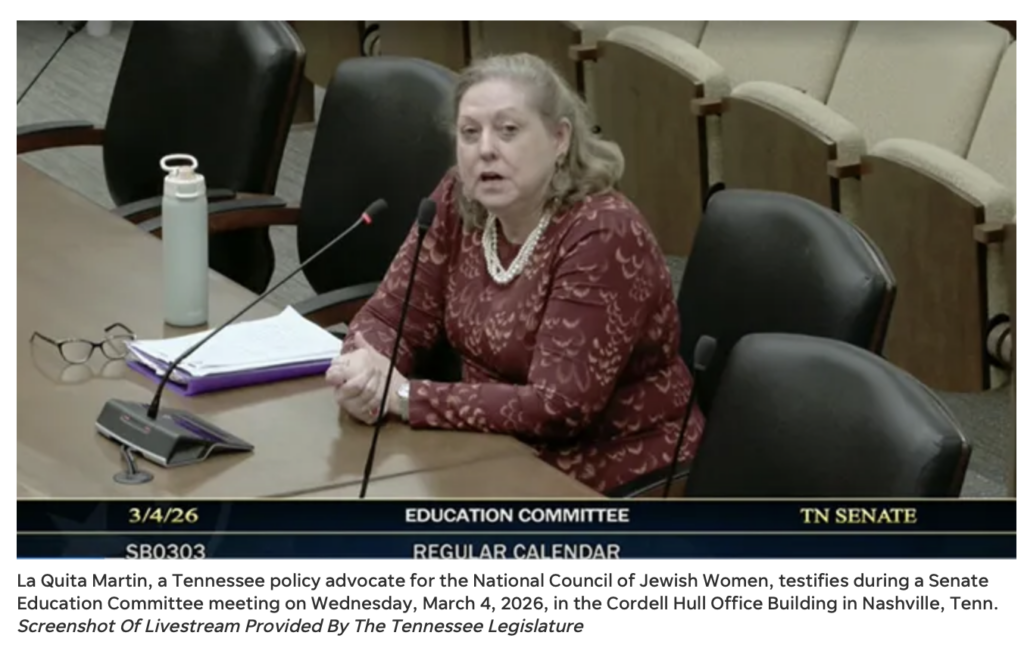
La Quita Martin, a Tennessee policy advocate for the National Council of Jewish Women, testified during the March 4 hearing on SB303 as lawmakers debated the display of the Ten Commandments in schools. She said she strongly opposes the bill, saying it trivializes a text that is sacred to many and excludes those who follow a “minority faith.” She also said Christian and Jewish traditions have different versions of the commandments. Additionally, she said displaying the commandments would “run afoul” of Jewish principles that generally oppose proselytizing.
“We believe that every person has the right to come to their own religious beliefs with the assistance of their family and faith community,” Martin said. “In the school context, that means that every student should have the feeling of belonging and should not depend on conforming to government-approved (religion).”
Nate Kellum, senior counsel at the First Liberty Institute, also spoke during the hearing and argued the bill is constitutional and would stand up to legal challenges.
Timothy Barton, president of Christian organization WallBuilders, also spoke in favor of the bill and laid out an argument that the Ten Commandments are historical documents and were part of public school teaching from the 1600s until a landmark U.S. Supreme Court ruling in 1980. Barton pointed to several historic textbooks on the desk in front of him that included the Ten Commandments. He also said the commandments and depictions of Christian figures like Moses are prominent in federal and state buildings.
“This didn’t used to be thought controversial, this was just the basic part of American education, and the Ten Commandments were the basis of all law in the Western Hemisphere, and so all students learned about the moral code,” Barton said.
Sen. Raumesh Akbari, D-Memphis, pushed back at Kellum and Barton, arguing that the Ten Commandments are not historical and that the bill is unconstitutional. She said she voted in favor of a previous bill that supports the teaching of the Ten Commandments in the context of American history.
“Putting them up in a school is a totally different avenue,” Akbari, who is the lone Democrat on the Senate Education Committee, said. “This is just another way to alienate people who are not Christians, and when they’re in school, it’s really not fair to do that — and I say that as a Christian.”
Tennessee education bills push for religious charter operators, prayer, curriculum
HB2000/SB2318, which would allow religious and church-related groups to run taxpayer-funded, public charter schools in Tennessee is expected to get its first House hearing on March 10 and its first Senate hearing on March 11 after multiple deferrals. It would also allow private schools and universities to operate them.
State law requires charter schools to be public, nonsectarian and non-religious. The Tennessee Constitution also states that “no preference shall ever be given, by law, to any religious establishment or mode of worship.” But bill sponsor Sen. Joey Hensley, R-Hohenwald, argues that his proposal remains constitutional so long as schools “don’t teach religion.”
The bill comes despite a U.S. Supreme Court ruling last year that blocked Oklahoma from authorizing a religious charter school. The court said it would violate state and federal law, which bar the state from establishing or favoring any one religion.
Here are a few other notable bills that involve religion and prayer in public schools that are set for hearings in the coming days:
- SB1714/HB1491: This bill would require public schools to teach the Bible as literature, but prohibits it to be used as “religious dogma” or to coerce students to accept it as divinely inspired. The bill also allows for voluntary time for prayer and reading of religious texts, outside of instructional time, and adds protections against legal pushback.
- SB1957/HB1834: The bill authorizes local public school boards to open a meeting with prayer led by a member of the board, so long as the board doesn’t require, harass or coerce those in attendance into participation.
- SB1828/HB1822: This bill carves out ways for schools to teach “the positive impacts of religion on American history in conjunction with instruction in American history.”
What’s next and how to follow along
While an end date has not been set for Tennessee’s current legislative session, lawmakers typically meet well into March and sometimes April.
You can look up a piece of legislation by entering either its House or Senate bill number into the search bar at the top right of capitol.tn.gov. For example, searching for SB303 would take you to the landing page for the Ten Commandments bill. You can find the status of the bill and when it’s set to be heard next there. You can also find videos of past hearings on the bill.
You can find a full calendar of hearings and their agendas by selecting the “schedules & calendars” tab along the top of website. You can also find livestreams of hearings on the “videos” tab. Keep in mind that livestreams will not be available until the scheduled hearing time and may start late due to previous hearings running long.